Version 29 Released

We are pleased to announce a new release to SOS.

This release brings many new features which includes the ability to connect your AI assistant.

See the video below:

New features:

MCP (Model Context Protocol) AI Integration

  • Added MCP server integration allowing AI assistants (e.g. Claude Desktop) to control the simulator
  • Added MCP Client Setup dialog for configuring AI assistant connections
  • Added comprehensive MCP tools: satellite CRUD, TLE import, scene/camera control, screenshots, data export, physics settings, project management,
    mission planner scripting, delta-V creation, thrust, labels, events, and more
  • Added MCP replay log and diagnostic replay app for debugging AI interactions
  • Added MCP notifications for user actions (project load, simulation start/stop, satellites)

Mission Planner / Scripting

  • Added CallScriptIf and CallScriptSwitch for conditional script branching with input variable support
  • Added FindApogeePerigee, FindNode, FindAtTime script functions
  • Added SetIntegrator function and integrator params to SetSimulationWindow
  • Added TargetApsisRadius script functions
  • Added SetSatBurnoutOrbit and Burnout to Orbit UI tab
  • Added satellite creation methods: orbital elements, burnout, parking orbit, Lagrange
  • Added Parse Script button for syntax-only validation
  • Added progress bar and cancel button during script simulation calculations
  • Added bool type coercion to Irony DSL

Orbital Mechanics & Physics

  • Enhanced Earth bulge model with J3 and J4 zonal harmonics
  • Improved drag/lift calculation: handle low velocity and LST bug
  • Added precise delta-V refinement using simulation feedback
  • Fixed Moon orbit creation bug; clamped perigee; added Moon orbit tests
  • Improved orbital period edge case handling and robustness for non-elliptical orbits
  • Added EventFinder improvements: culmination jitter fix, missing burns, pre-epoch guard
  • Added satellite pitch parameter support

UI & Layout

  • Migrated shell layout from frame navigation to Syncfusion DockingManager (docking/floating panels)
  • Added “Play Backwards” simulation control
  • Added Manage Labels dialog
  • Added themed borders, dark mode fixes for auto-hide tab strips and floating windows
  • Changed button text from uppercase to normal case globally
  • Added proprietary licence, third-party notices, and licence UI tab

Window Management

  • Added single-instance enforcement: activates existing window instead of launching a second copy
  • Remember window size, position, and state across restarts

Version 28 of SOS now released!

This version sees the product improved in several areas. Some of the highlights are listed here:

  • You can now create videos of a simulation. These videos can include simulation data on screen and be pre-programmed to change parameters like simulation speed and camera view during the simulation by using our Mission Planner. Videos can also be 3D and 180 degree Field of View, to be viewed in a VR headset.
  • You can also create snapshots (photos) at any point within a simulation. These can also be 3D and 180 degree Field of View.
  • Exporting of events is now possible.
  • It is now easier to get the camera views you want during the simulation, with a new comprehensive set of camera controls .
  • We’ve added a few satellite models, including an asteroid!
  • The Mission Planner has features and functions, too many to list here.
  • The tutorial is more extensive, with new topics added.

Why don’t you check it out and try it for yourself?

Home Page  Wiki  SOS Videos  Download the Application

Changing the way Orbital Mechanics is Taught

With the advent of modern high-speed personal computers, why do we still teach astrodynamics/orbital mechanics using Kepler’s equations?  When I taught astrodynamics 40 years ago at the USAF Academy, we used the Bate, Mueller, and White book Fundamentals of Astrodynamics. It presented space flight using highly complex, mathematical gymnastics based on Kepler’s equations of planetary motion.

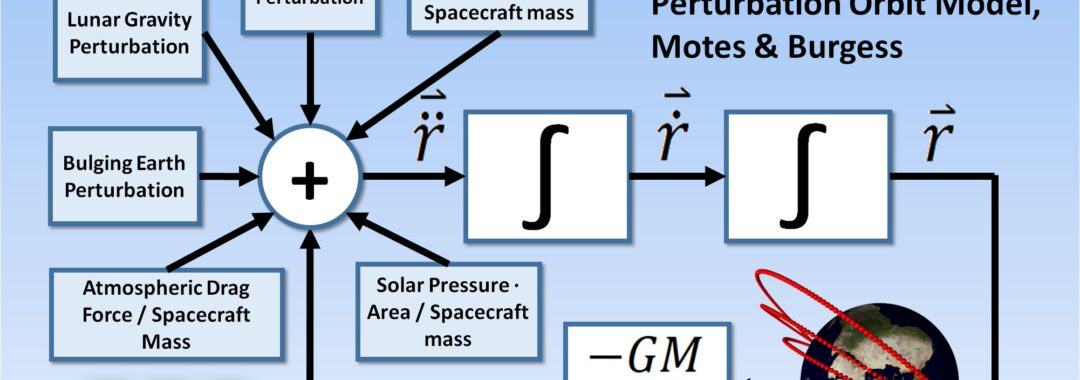
In fact, it can be taught using basic physics and the equation of motion for the spacecraft under the acceleration of Earth gravity with perturbations from other sources such as Sun, Moon, Earth bulge, Earth atmosphere, solar pressure, and thrust (see image below).  Since equations are available for the position of the Sun and Moon relative to the Earth-centered Inertial (ECI) coordinate system, you don’t need to do an n-body equation of motion.

This spacecraft equation of motion can easily be solved by computer using a double numerical integrator with small time steps making it very accurate.  Missions that require months can now be solved accurately and quickly using your laptop computer in less than 10 seconds. You can even propagate spacecraft backward in time.

This is how we do orbit simulations using SOS. It’s designed for education and allows you to do the simulations with or without any of the perturbations so you can see the effects of perturbations.

Andrew Motes